Vistas de página en total

martes, 23 de mayo de 2017

Key concepts


  • Plastics consist of long chains of atoms which are mostly composed of carbon.
  • Plastics can be classified into natural and synthetic plastics.
  • The process of manufacturing plastics is called polymerisation.
  • Plastic materials are resistant, insulating (aganist electricity, heat and sound), ductile, malleable, impermeable and light.
  • Threre are three types of plastic recycling processes: chemical and mechanical recycling and energy recovery.
  • Thermoplastics are usually made from petroleum products. The most common thermoplastics are: 
      - Polyethylene terephthalate (PET).
      - High-density polythylene.
      - Polyvinyl chloride (PVC).
      - Low-density polyethylene.
      - Polypropylene.
      - Moulded polystyrene.
      - Expanded polystyrene or Styrofoam.

  • Thermosetting plastics are made from petroleum products. They include:
      - Polyurethane
      - Bakelite
      - Melamine
      - Polyester resins
  • Typical elastomers incluide rubber and neoprene.
  • Various industrial techniques can be used to manufacture plastic products, such as: extrusion, calendering, vacuum forming and moulding.
  • The main techniques for using moulds are as follows: blow moulding, injection moulding and compression moulding
  • Modification techniques use tools and machines to make changes to prefabricated materials, such as sheets, bars or moulding.
  • Both natural and synthetic fibres can be woven to make a variety of textiles. 
  • Natural fibres may come from animal sources (wool, silk), plant sources (cotton, linen, esparto, bamboo) and mineral sources (gold, silver and copper fibres)
  • Synthetic fibres, such as nylon, polyester, rayon and Lycra, are plastic materials.

martes, 9 de mayo de 2017

Basic devices made with electronic components

Timers

A timer is a device that operates for a certain period of time and then shuts itself off automatically.

Integrated circuits

Integrated circuits consist of miniature electronic components, such as transistors, resistors and capacitors.


Transistors

Transistors are basic components of electrical circuits. They are made from semiconductor materials and have three electrodes called the base, the collector and the emitter.

Diodes

A diode is an electronic component made from semiconductor materials. a diodes has two electrodes: an anode and a cathode.

Resultado de imagen de DiodesA LED only gives off light when an electric current flows through it.

domingo, 7 de mayo de 2017

Capacitors

Capacitors are components that can store an electrical  charge.

The value of a capacitor indicate the charge in volts that it can store. This is measured in farads (F). 


Resistance that depends on a physical factor

Resistance that depends on temperature is called a thermistor. There are two types of thermistor:

- Negative temperature coefficient (NTC): The resistance decreases as the temperature rises.

- Positive temperature coefficient (PTC) The resistance increases as the temperature rises.

LDR: Resistance that varies according to the amount of light received. THe resistance decreases as the amount of light increases.

Variable le resistance or pontentiometer

The value of a variable resistance or pontetiometer can be adjusted between zero and the maximun value specified by the manufacter.


sábado, 6 de mayo de 2017

Fixed resistance or resistor

A fixed resistance or resistor opposes the flow of electric currents. Its value, Which we measure in ohms, is indicated by code of colours and number.


Resultado de imagen de code of colours and number.

Electronics

Resultado de imagen de Electronics
Electronics involves the study of circuits and components that the intensity, direction r properties of electric currents.

sábado, 22 de abril de 2017

Limit switches

Limit switches are contact sensors that display an electrical signal, in the presence of a mechanical movement. They are widely used in industrial environments to censor the presence of objects in a specific position. They are used in various applications.
Resultado de imagen de limit switches definicion

Cam switch controller

Resultado de imagen de Cam switch controller
The device on the side of the pulley in the picture above is called a cam. They shape of this device allows us to control the moment and duration of an activity, such as the runing of a motor or the illumination of a light bulb.


miércoles, 19 de abril de 2017

Electromagnetic control systems

An electromagnetic cotrol systems activates the various parts of a machine, at the right moment and for the right amount of time, ensuring that the machine funtions properly.

martes, 18 de abril de 2017

Relays

A relay in a electromagnetic component that works as a switch. The coil attracts a moveable metal contact towards another fixed contact. When the elctricity stops flowing, the moveable contact goes back to its original position.


Resultado de imagen de Relays

Electric motors

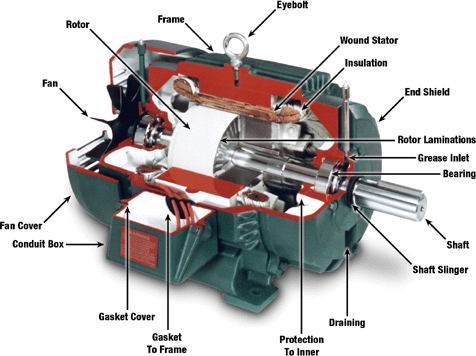
An electric motor is a device that can transform electrical energy into movement. It ises the forces of attraction and repulsion between a magnet and an electrically-charged wire.


Resultado de imagen de Electric motors

Electromagnetic generators

Dynamos

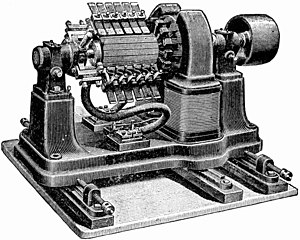
A dynamo consists of a magnet and rotary coil. These conductors are attached to carbon bruses, which in turn are connected to electrical wires. When electricity is applied to the coil, it rotates and begins to generate direct current in te coil.
Resultado de imagen de Dynamos


Alternators

A simple alternator nis almost to a dynamo, except for the commutator, which consists of two matallic rings connected to carbon bruses instead of direct current, this produces alternating current.


Resultado de imagen de alternators

Electromagnetic mechanisms

Electromagnetic mechanisms are devices that can corvert movement into electricity or vice versa. In other words, they use electromagnetic phenomena to produce electricity or convert it into mechanical


Resultado de imagen de Electromagnetic mechanisms


martes, 4 de abril de 2017

Sound

Resultado de imagen de SoundWe can transform electric current into sound by using electromechanical devices, such as bell and buzzers. Some of these devices are based on the piezoelectric effect, or the ability of some materials to change shape when electricity is applied to them.

Electromagnetic Effects

In this experiment, the elctric circuit has created a magnetic field. This effect can be used to produce movement.
The scientist Michael Faraday discovered the opposite effect. He notice that electricity could be generated by using a magnet and an electrical conductor. This priciple allows us to build dynamos and alternators.


Light

Resultado de imagen de incandescent bulbs

Incandescent bulbs

When an electric current passes throught the metallic filament of a light bulb, it produces light. This phenomenon is called incandescence.


Fluorencent tubes
Resultado de imagen de tubo fluorescente

Inside a fluorencent tube, there is a metallic filamen, normally made of tungdten. There is also an inert gas, such as argon, and a small amount of mercury.


Light- emitting diodes (LED)

Resultado de imagen de light emitting diode (led)A light-emitting diode (LED) has layers of semiconductor materials.When electricity is applied to the LED, the electrons and holes cross over into the active layer, where they combine and produce photons, or particles.

Heat

Resultado de imagen de heat electric currentThe energy that an electric current produces as heat is called the Joule Effect. It is expressed by the following formula:

E = I^2 x R x t

Most of the energy that is consumed by radiators and heaters is converted into heat.


Resultado de imagen de heat